
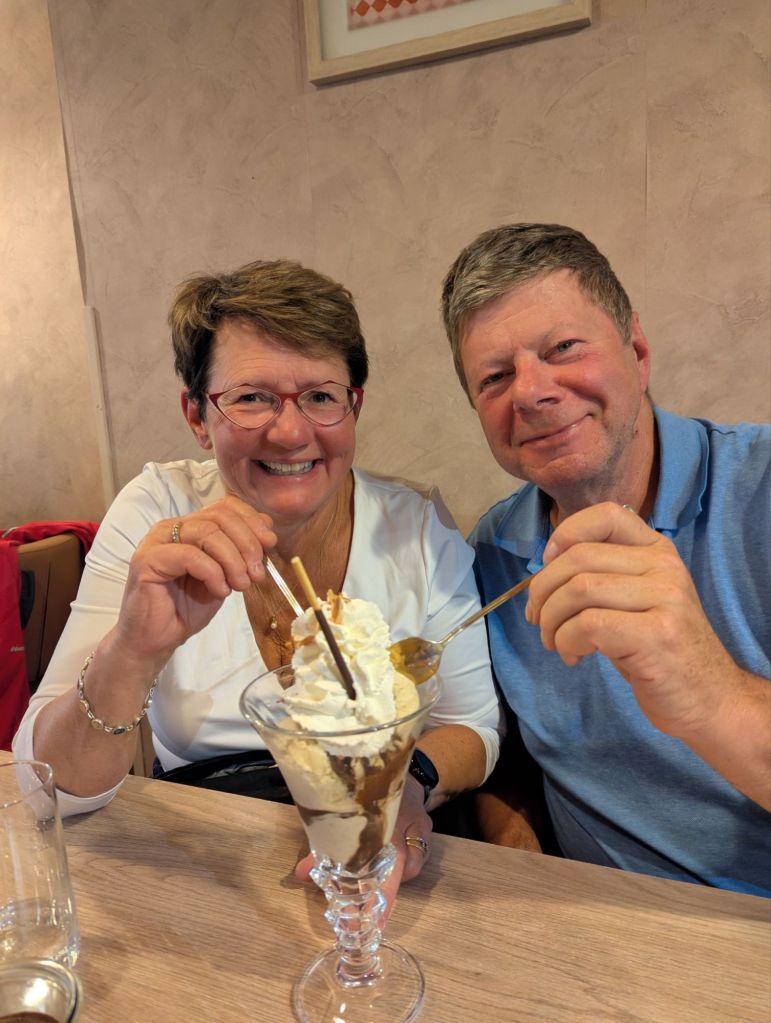
Julius Caesar wrote “Gallia est omnia divisa partes tres” in the 1st century BC. Remember your high school Latin? That’s all I recall despite 3 years of Sister Clarice’s efforts. I then had one year of self study French in senior year. I don’t remember any of that either. Seems Dan and I share a language-learning handicap. Nevertheless, Greg and I went (back) to France to conquer, coincidentally, all 3 parts of Gaul! With us were our good friends Jeanette and Allen with whom we had traveled to Italy and Antigua in the past.

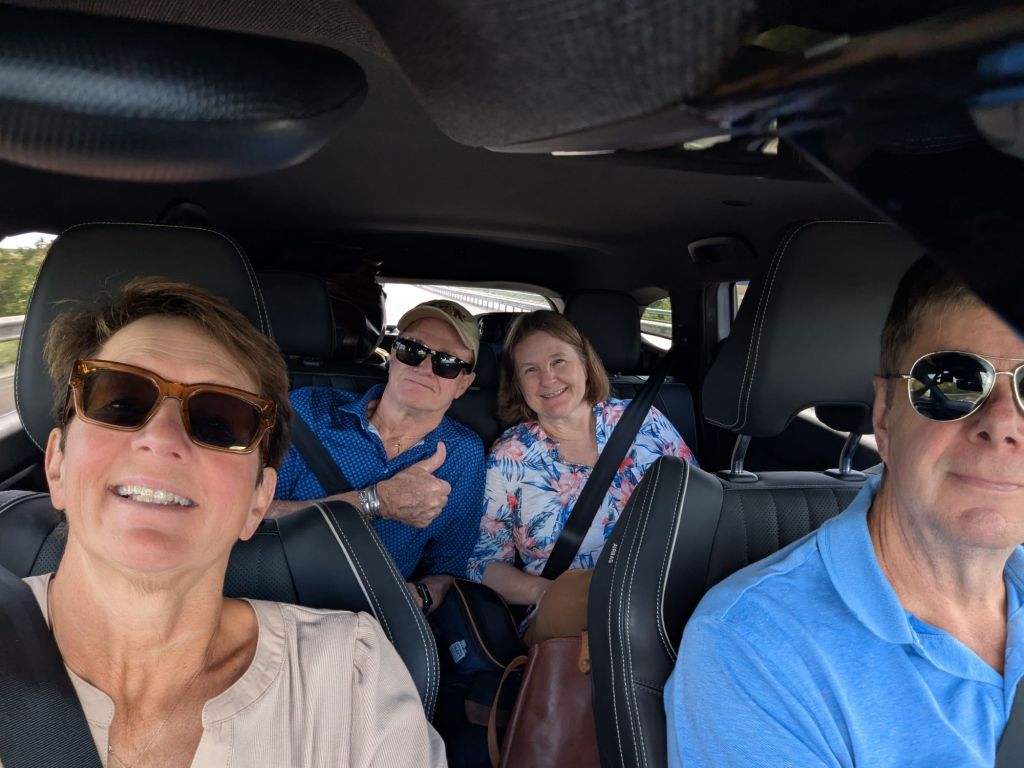
Our flight to Paris was uneventful (yay!). We picked up the rental car (Renault E space hybrid) which was just barely big enough for luggage for the 4 of us. Bags crammed in, we started our French adventure while trying to work out the rental car specifics enroute. You can always tell a rental newbie when they run the windshield wipers on a sunny day. Another test was the deciphering of the highway toll signs. If you can’t figure out the manual toll payment system, you can always go online within 72 hrs to pay (sanef.com).

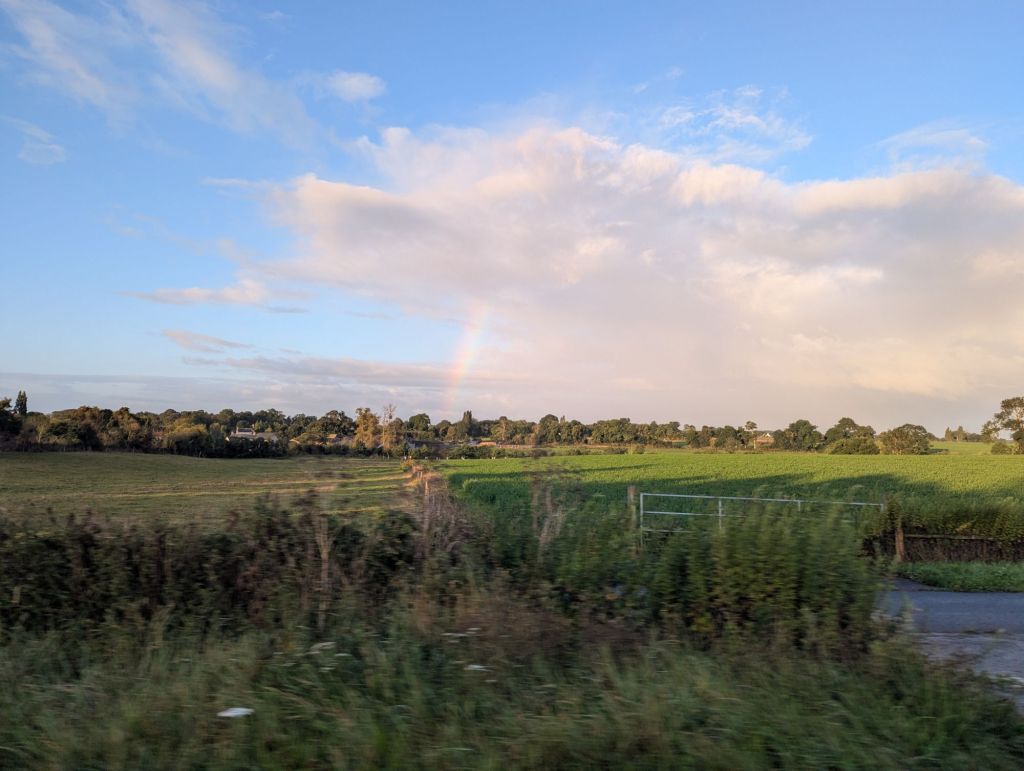
Automobile and driving specifics aside, we headed north east 2 hours to Reims (pronounced “Rance” with nasal emphasis on ‘an’). In Gaul, this would have been “Belgica” but is now known as the Champagne region. Once out of Paris and its surrounds the landscape opened up to rolling green and gold pastures, some fields harvested and others with waving stalks of mature corn or wheat. Even from a distance we could see the cathedral as we approached Reims. A smallish city of about 200,000 pop., Reims has ancient Roman beginnings and continued significance in history as the place where Frankish/French kings were coronated from when the first king, King Clovis, was baptized in 496AD here to where General Eisenhower and the Allies received the unconditional surrender of the Wehrmacht in 1945.
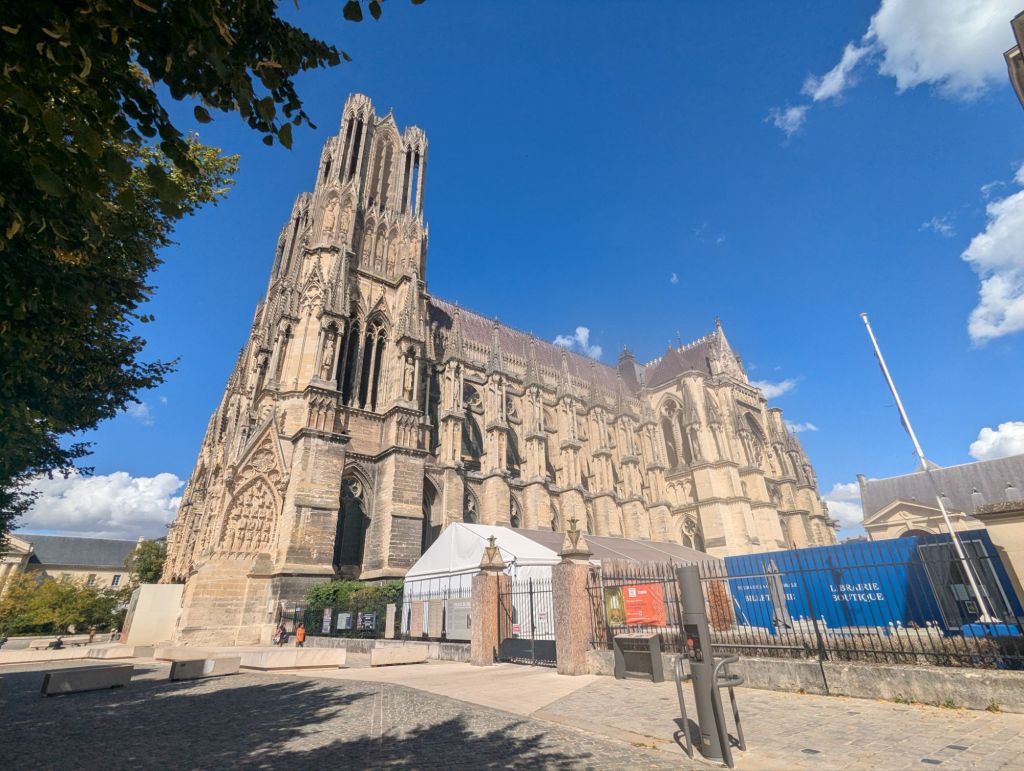
Greg drove us to within a block of the Reims cathedral of Notre Dame, with only 1 or 2 unexpected u-turns on narrow, one-way streets. We found parking and took only about 10 min to figure out the parking payment machines (with a little help from a local). Some machines prefer credit card tapping, some prefer insertion, it’s a guessing game.

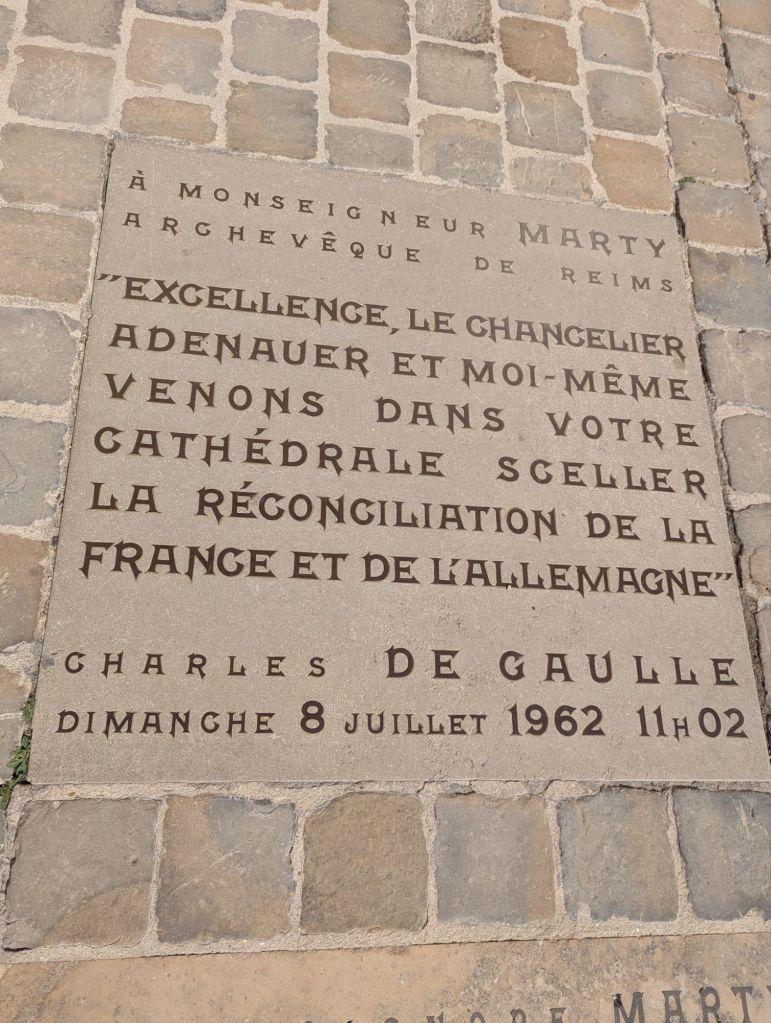
The cathedral Notre Dame de Reims is fantastic in size, decoration, and history. Most recently, well, relatively compared with the Romans and Gaul or 11th century coronations, the Notre Dame cathedral was severely damaged in WW1 by German bombing which reinforced anti-German propaganda. Post-war restoration was significantly funded by American John D. Rockefeller. The results are stunning; the highly decorated exterior displaying many statues and sculptures of kings and biblical figures, gargoyles, and wedding cake-like decorations made of mortar or limestone. The soaring ceilings in this Gothic cathedral are lit with mostly clear glass windows, many of the stained glass destroyed in WW1 or removed in the 19th century in an effort to brighten the interior. The area behind the altar has highly stylized stained glass created by Marc Chagall in the 1970s, with elements of Judaic and Christian storytelling. WW2 saw less damage (but still some) to Reims and the cathedral. Gen. Eisenhower received the surrender of Germany here on May 7, 1945, and later, symbolically, Pres. De Gaulle and German chancellor Adenauer signed a document of reconciliation here in 1962.


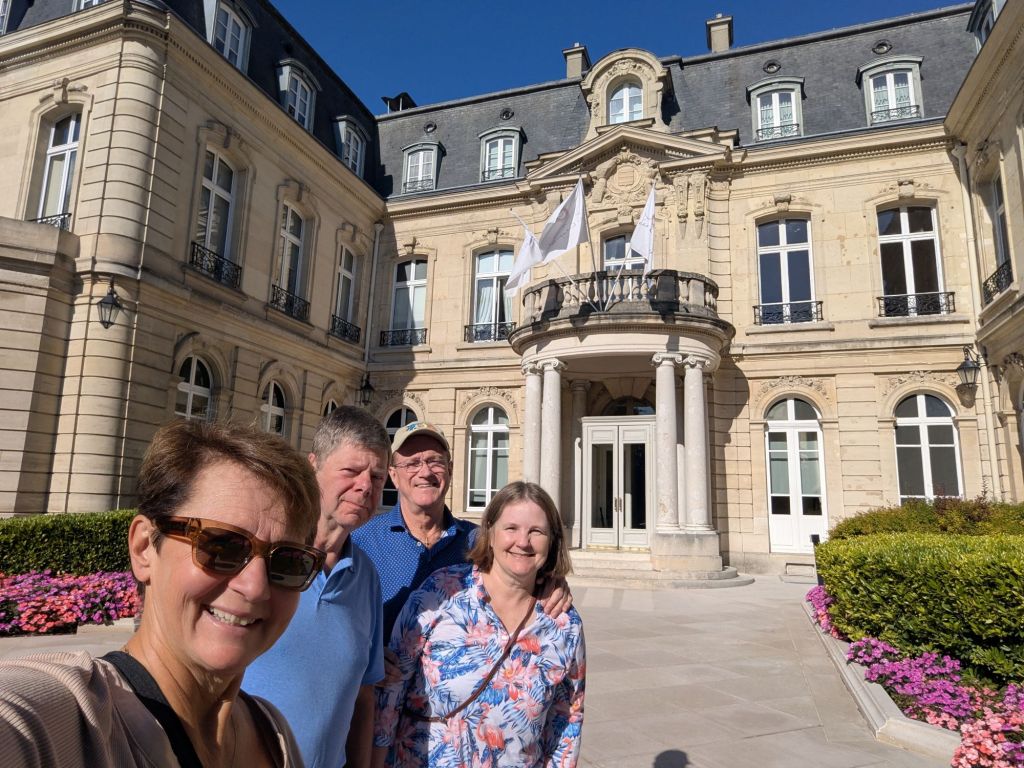
We returned to the car, always relieved it remained where we left it, and headed to our nearby hotel, Domaine les Crayeres. We planned this trip with Erica Harnett of ProTravel, whom we had worked with before. The hotels she recommends are always wonderful and in this case, top end. Wow, a great beginning to our stay in France. Greeted with champagne and then dining in their restaurant, mmmm, tres Bien.
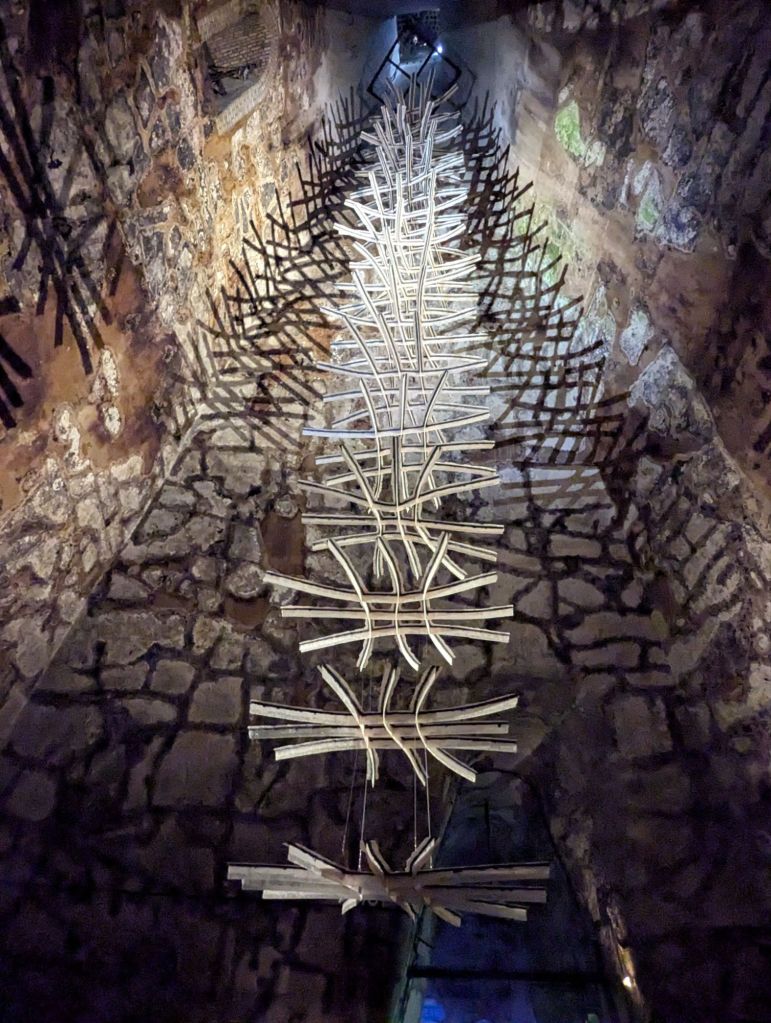
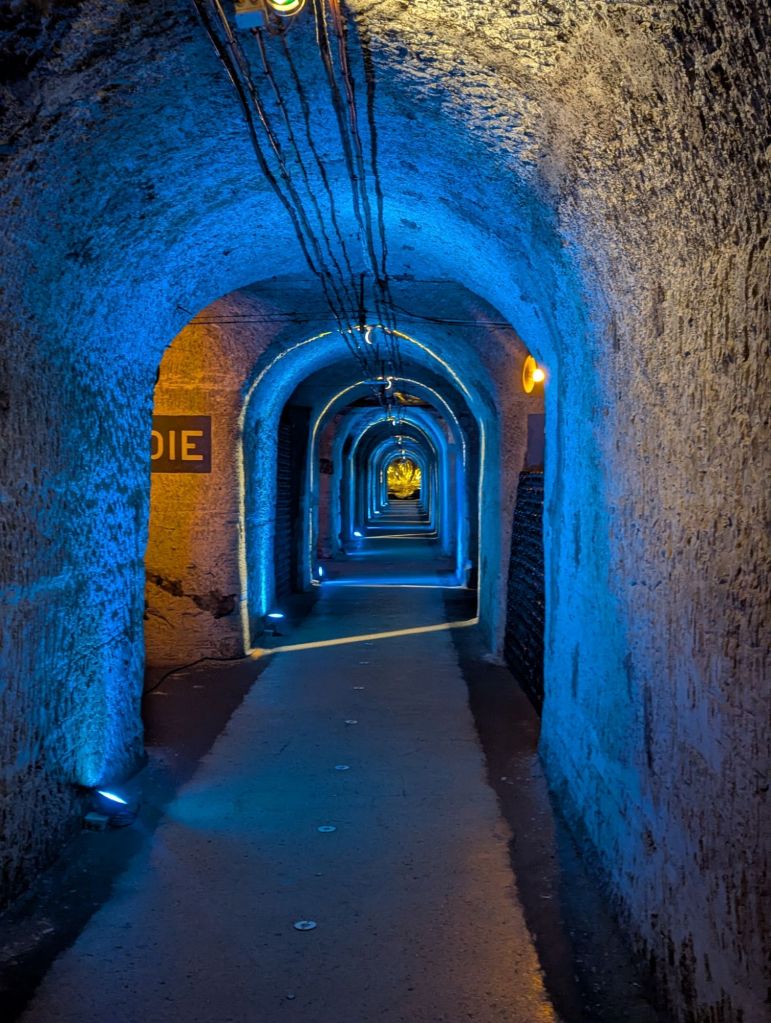
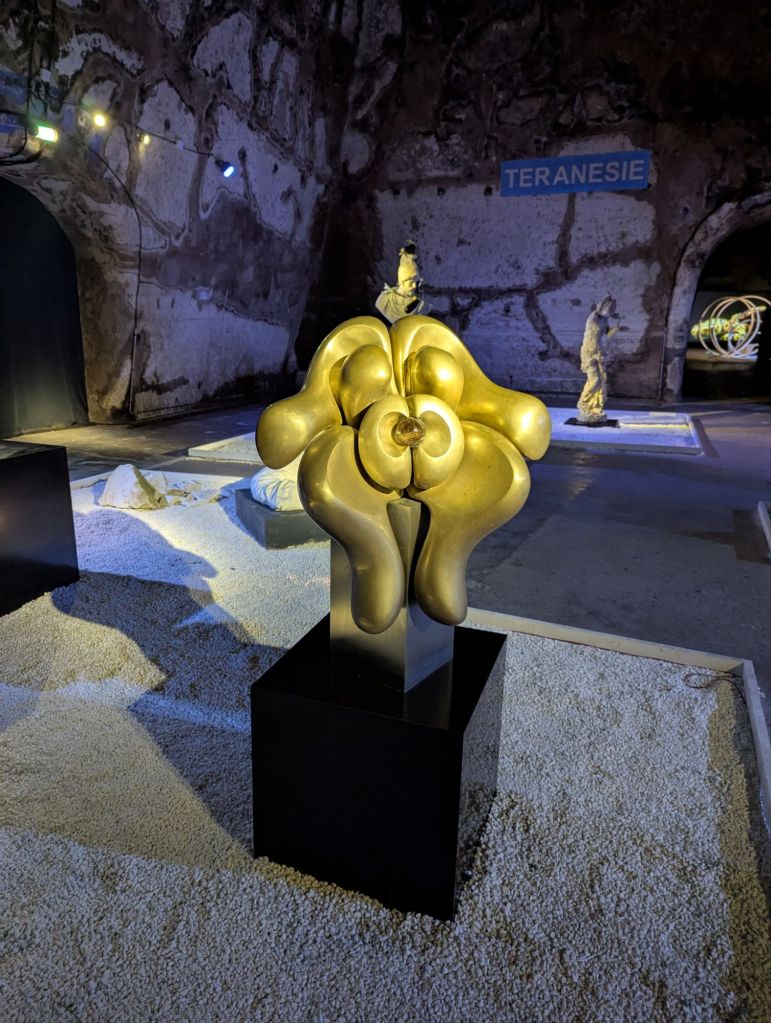
Oh, did I mention champagne? Reims is in the north of the champagne district of France so we were sure to sample the fruits of the region. The next morning, after a lovely breakfast of French breads, cheeses, pastries, omelets, and oui, champagne, we headed over to Vrancken Pommery house to tour the champagne cellars. Madame Pommery oversaw the conversion of local Gallo-Roman chalk caves into champagne cellars in the 19th century. Multi colored lights illuminated 120 steps down 30 m into the 18 km of tunnels now housing 20 million champagne bottles at various stages of fermentation and delightfully, art installations to view and enjoy all along the way. And yes, a champagne tasting at the end of the tour.


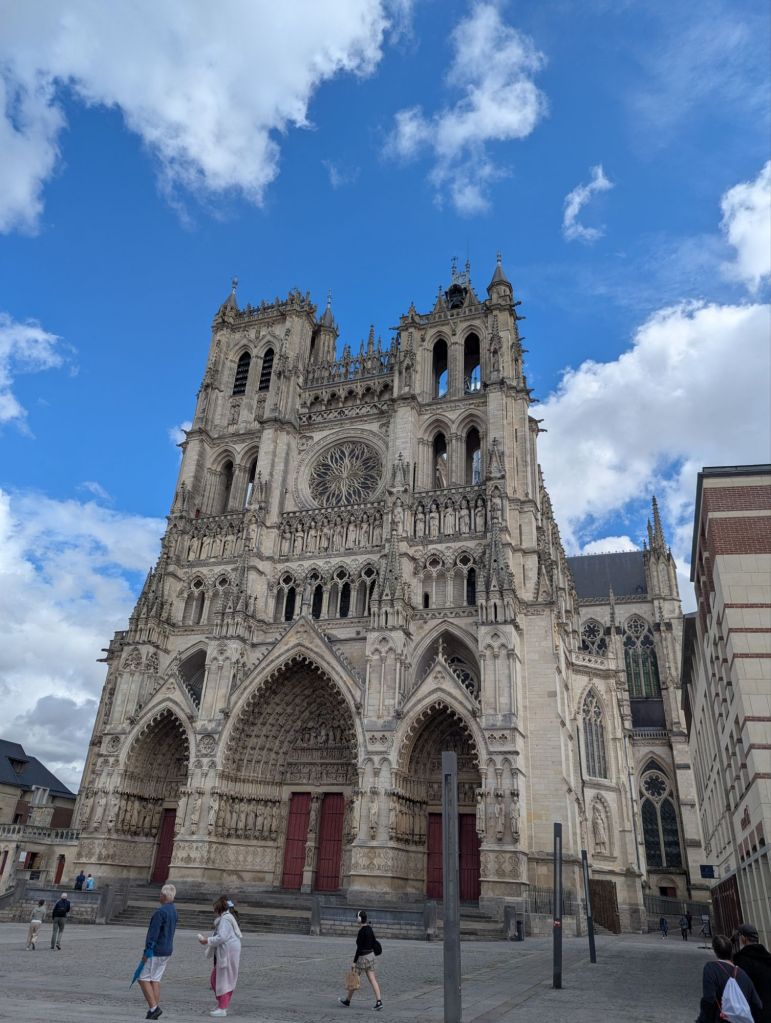
We then headed west towards Amiens, about 2 hours away, to visit Notre Dame d’ Amiens, France’s largest cathedral. The highway was bordered by more idyllic pastures and potato fields dotted with stone houses and barns with red tiled roofs. Stately white, silent windmills spun slowly above. The Gothic cathedral Notre Dame d’Amiens is the largest in France, not as highly decorated or with as much statuary as in Reims, but beautiful with the soaring curved ceilings held up with graceful pillars like trees holding up the sky. Typically in these cathedrals, the main altar and choir are enclosed behind carved wood or stone screens, or roods, but side altars celebrate various saints. A relic of St. John the Baptist is on display in one of them. The organ sits up high in the back, assuming the organist does not have a fear of heights. After our visit we sat across the square at a cafe enjoying the cathedral view and a tea, coffee, or beer. Amiens is Jules Verne’s hometown, btw. Back in our Renault we decided to skip Rouen for now as there was another 3 hours of driving to the next destination, Bayeux, and our hotel, Chateau Carnivere. This chateau is slightly more modest than our last, but has some history as a farm, then Nazi headquarters then British headquarters before eventually becoming a beautiful hotel. The restaurants, les Botaniste and les Petit Jardinere, served fabulous fresh food. My plan is to start out wearing belted slacks and jeans and then switch to elastic waisted pants as the trip proceeds.


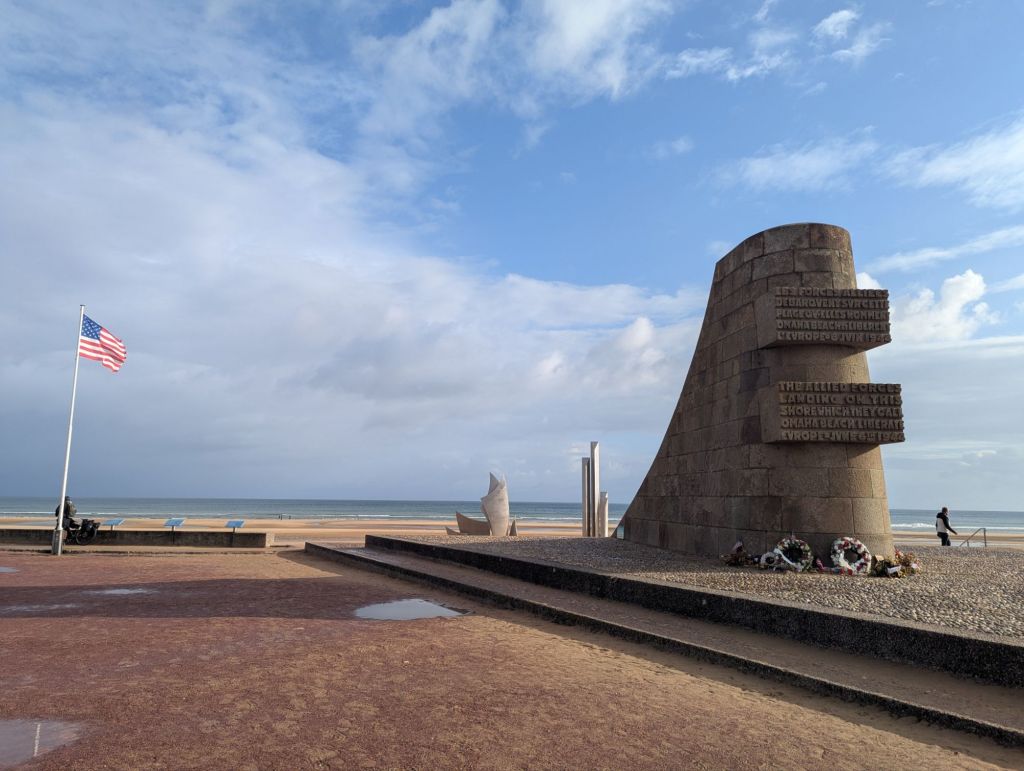
Bayeux, in the Normandie region, was our starting point for the next 3 days. We signed onto a full day history tour of Normandie and WW2 with Bayeux Shuttle. The tour director, Fred, was pleasant and knowledgeable and the van of 18 guests was friendly, everyone earnest in their desire to learn about Operation Neptune: the Allied landings at Omaha and Utah beaches (as well as Gold, Juno, and Sword). Previously, Dieppe was a failed attempt by the Allies to win entry into France via an established harbor; Operation Neptune landing sites were selected as they were situated between established harbors. Omaha Beach was our first stop. This 5 mile expanse was the landing site of 34,000 US troops, brought over on plywood ‘barges’ mid-tide. Weather played a huge role in the success (and some failures) of the Allied landing on June 6, 1944. With superior meteorological prediction, (and the insistence of young Irish meteorologist Maureen Sweeney), the Allies were able to take advantage of a break in a 3 day storm (coinciding with a full moon and favorable tides) that the Germans luckily did not anticipate. Weather and winds did affect infantry and paratrooper landings and aerial bombings. The magnitude of the operations: the secrecy, planning, #s of men, equipment, timings, collaboration with different military services and countries, it’s amazing it all worked out in the end. *Apologies to the soldiers, military services and historians for simplifying the battle information and for inaccuracies.

On average at the D Day landings, the American infantrymen were 24 years old. Their only mission was to cross the beach, where German guns were positioned to shoot down the length of it. 34,000 soldiers landed, but 2,400 did not make it. Despite the odds, they won their objective by the end of the day: to capture the bluffs and hold the beach. In the days following, “mulberries” were sunk to create a manmade harbor and floating roads were installed. The Allies now had an entry into Western Europe. Omaha Beach itself was now empty but for monuments to the Allied invasion and quiet waves. Homes and small resorts line the road that follows the shoreline, as they did prior to the war.

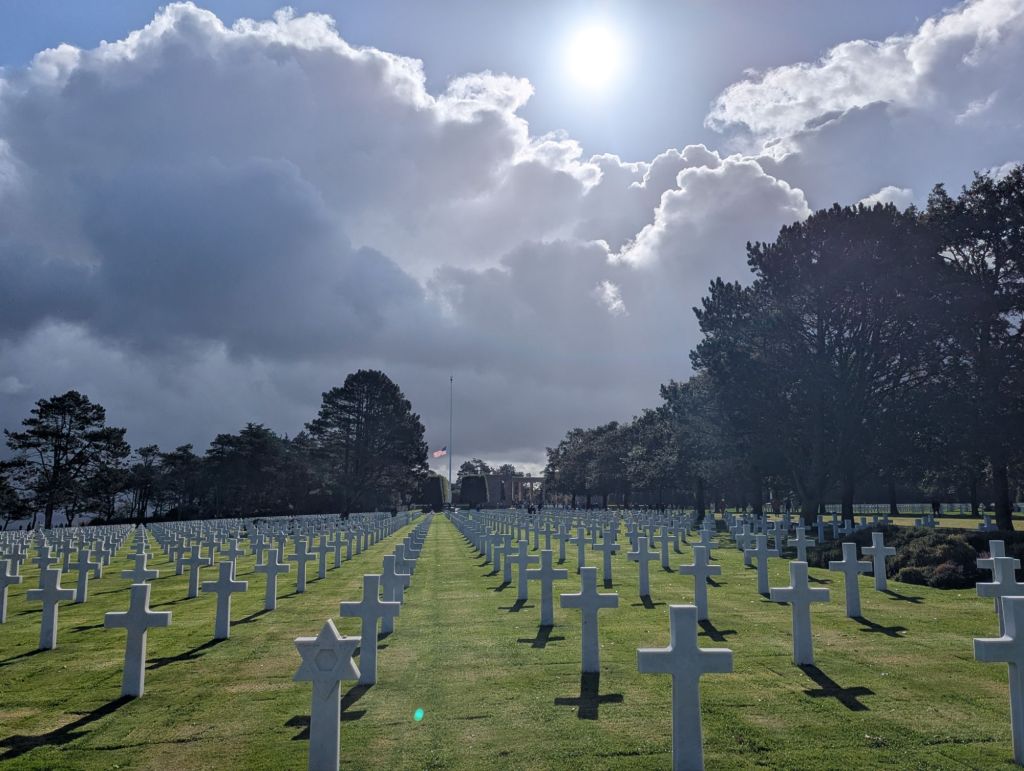
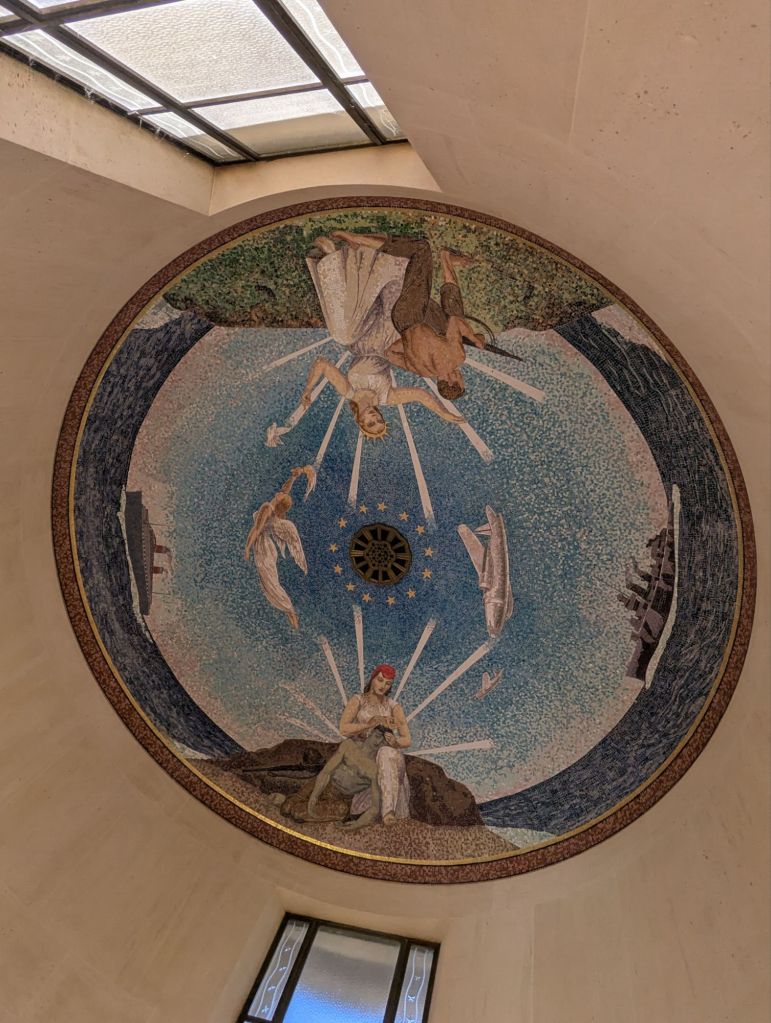
From Omaha we continued to Colleville, the American cemetery. Of 160,000 Allied soldiers that landed on D-Day there were over 10,000 casualties, 6,000 US. Rain had started but by the time we walked the 5 min from the van to the cemetery, sunshine broke out amongst the clouds. Soldiers are buried randomly, and without birthdate, as all are equal in death. The white marble crosses and stars of David gleamed in the sun. A small chapel has a mosaic ceiling of symbolic Columbia leading her boy/man soldier to Marian who will receive him as her own in France. Walking amongst the headstones, 2 French fighter jets flew very low, overhead. It was 9/11, particularly sombre and meaningful.

Onto Pointe-du-Hoc, where US Rangers landed on D Day to scale the cliffs and capture German guns in support of the beach landings. The assault on the cliffs was delayed and when they got to where the guns should have been, they found none. The bunkers and pillboxes were still under construction but, luckily, they did find and destroyed 5 of the 6 guns hidden in a nearby orchard. The 6th gun had already been destroyed in an aerial assault. Only 90 of these 225 US infantrymen were still fighting after 2 days.


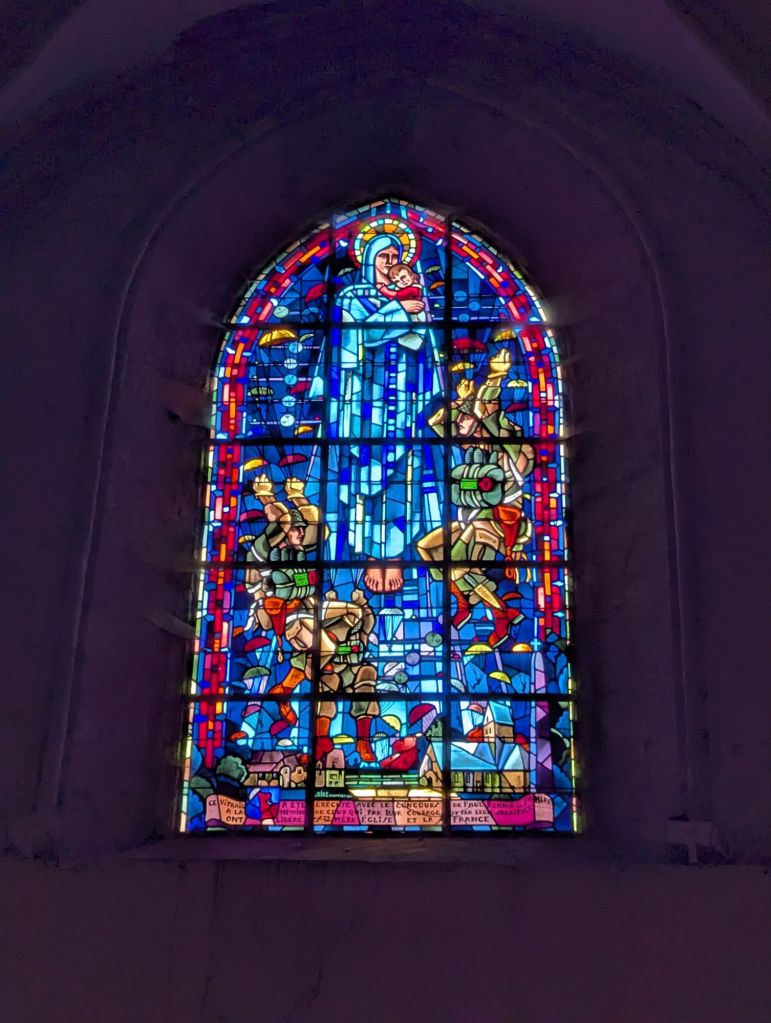
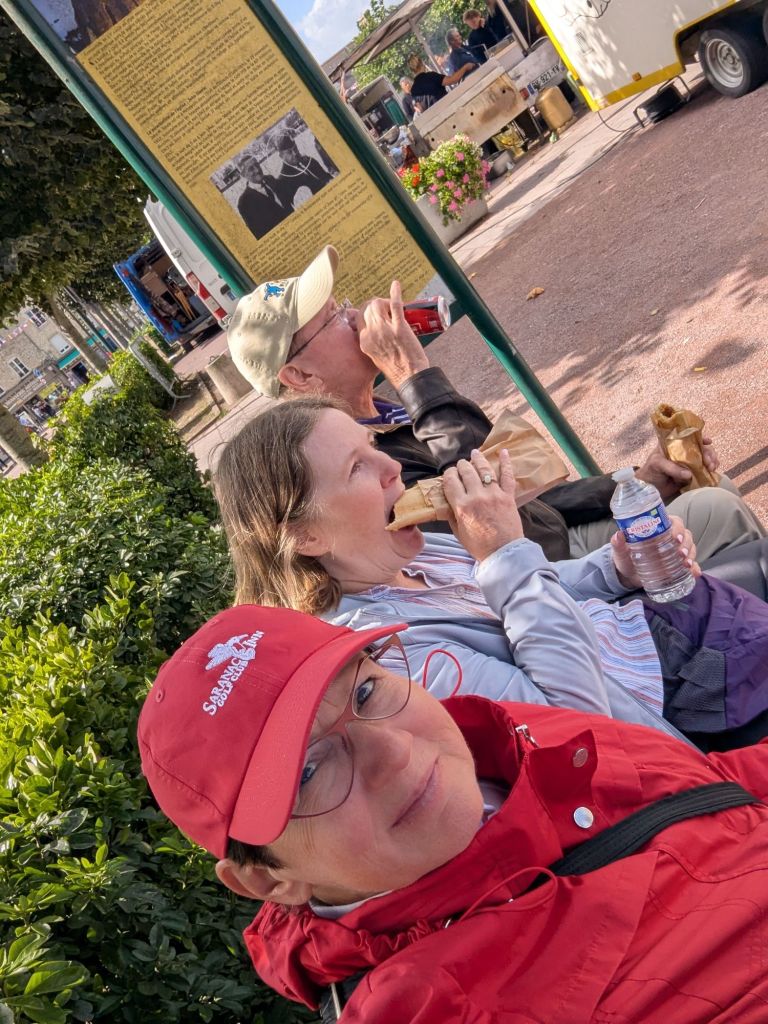
Our tour then took us to Sainte Mere Eglise, the first town liberated on D Day (although other villages claim the same). Paratroopers landed here, near Utah Beach, with the mission of keeping bridges and causeways open. Rommel had flooded the marshes nearby, reversing the mechanisms on the locks that drained the fields. It was important to keep the travel paths clear for troop, artillery, and supply movements for the invasion. One paratrooper, John Steele, got snagged on the spire of the local church, was captured by the Germans, but managed to escape and eventually fought in other battles. There is also a great Airborne Museum here with many war mementos and displays and an original C47 plane and a glider. Also one building housed a simulation of the noise, lights, and reverberations of an attack which was pretty distressing to me. We didn’t have a lot of time to spend there but it’s worth visiting (tell them “Fred” sent you for free entry). We enjoyed a very large grilled sausage sandwich and fries from a food truck at the market in town. Seems that everything closes up from 12:30 or 1:00 to 3:00pm or later (French ‘siesta’?).

Driving past more fields and pastures spotted with bomb craters, we went to Utah Beach. (Here’s a tip: cows grazing in a pasture indicates no mines present). Utah Beach was secured by Allied troops with fewer casualties, 197/21,000 infantry but 2,500/14,000 airborne. Aerial assault was more successful here resulting in fewer overall casualties. The objective was to cut off Cherbourg at the top of the peninsula, which was achieved. Combined with the success at the other beaches, Operation Overlord landed 2 million men and began the western assault on the German forces. A good documentary to watch is Liberation Day: D Day to Berlin from National Geographic. The whole scenario was overwhelming and too much to recount here. That said, this tour was amazing and well worth visiting and learning.


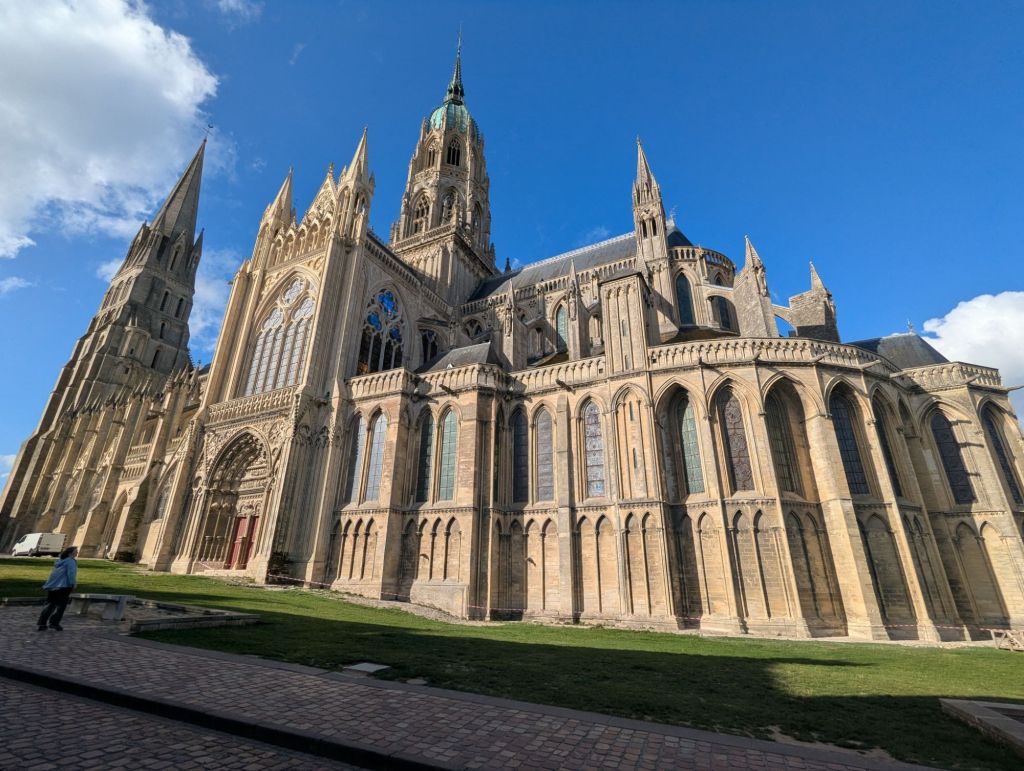
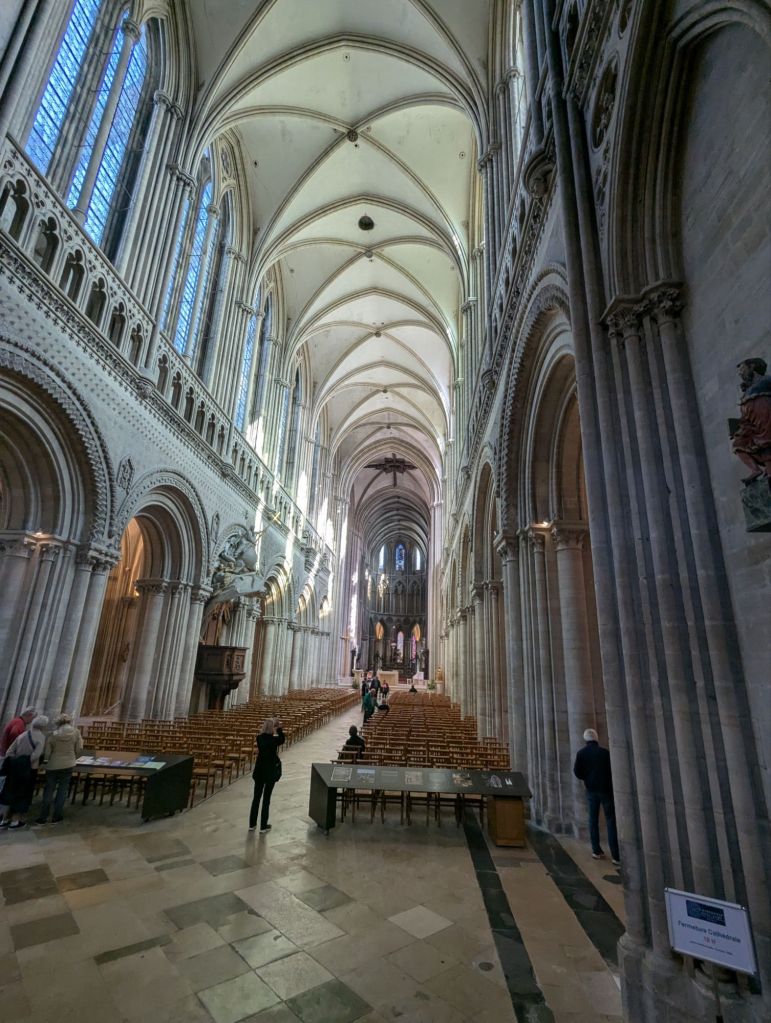
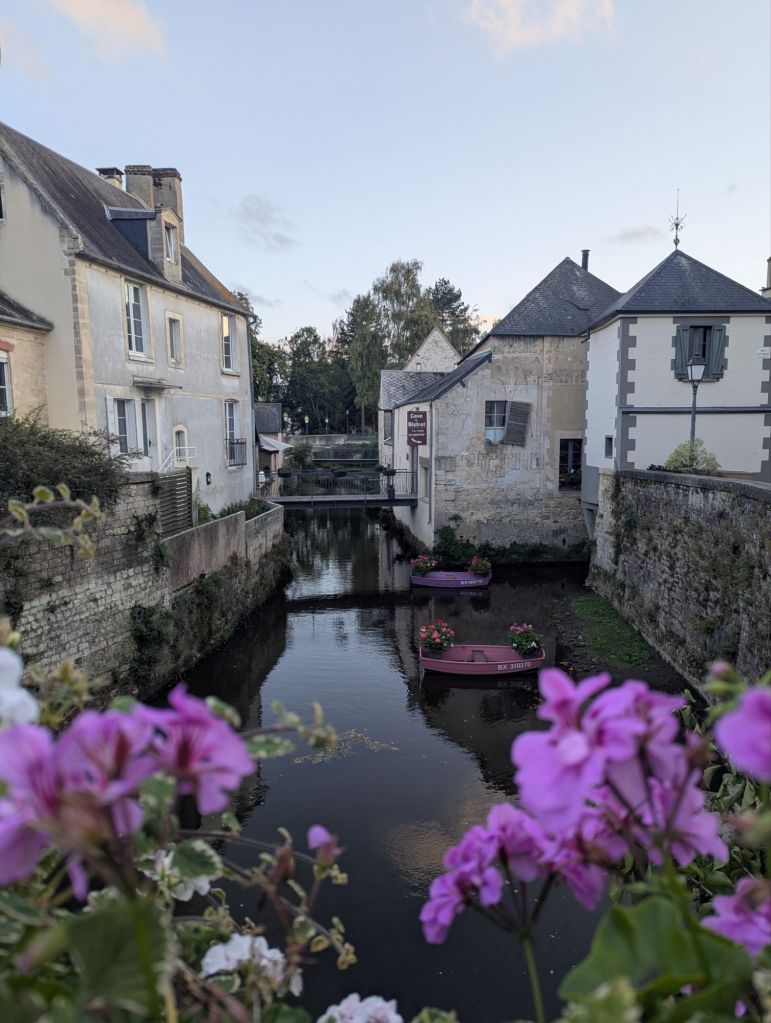
The tour ended back in Bayeux, which was never bombed, thankfully, due to incompetence of the German occupiers. The cathedral here remained intact and is quite beautiful. Built in 1077 of Gothic and Romanesque architecture, it housed the Bayeux Tapestry for a few centuries. However, we were not able to visit the famous tapestry, woven between 1066 and 1077 AD which detailed the conquest of England by the Duke of Normandy. The museum that houses it is under renovation and controversy surrounds whether the huge tapestry (70m long) should be moved and loaned to England. Historically, the tapestry provides a lot of details on food, dress, and social culture of the time. We did stay in town for dinner where we met a woman travelling alone and invited her to join us which she gratefully did. Hollis, of Florida but originally Long Island, was travelling on her own when her husband took ill with a respiratory illness and could not join her. Brave lady!
Next blog: more of Gallic Belgica and then, Paris!
Next blog: https://retirementadventureblog.com/2025/09/24/tour-de-france-parte-deux/

 My new reality
One thought on “Tour de France”