

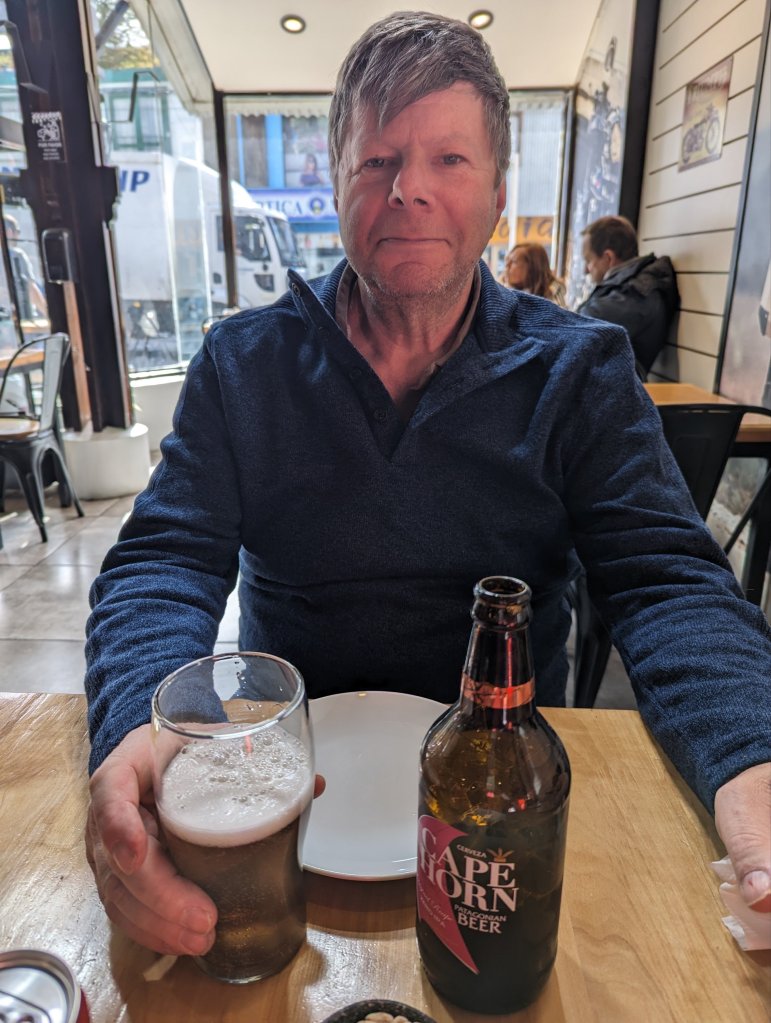
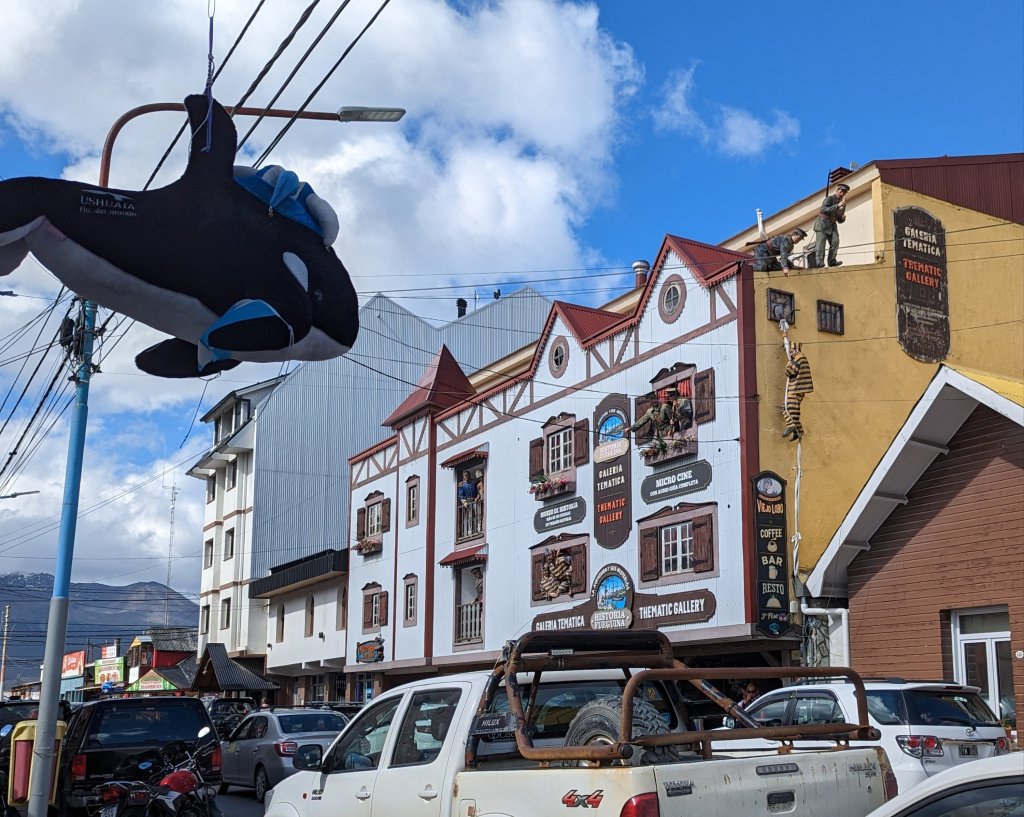
Geographically speaking, not literally, Ushuaia is nicknamed “the End of the World”. Capital of Tierra del Fuego and the southernmost tip of South America, the city of Ushuaia hugs the shoulders of the enormous jagged mountain peaks of the Marshall Mountains with the Beagle Channel at its doorstep. We arrived Wednesday mid-day t@o a partly sunny sky with lots of wind and about 48 degF. A small spur of flat land served as the airstrip. A short cab ride took us to our hotel, the Cilene del Faro. We walked the town after checking in. Not much to it, though Ushuaia is a ski town and a launching place for the Antarctic so there were plenty of ski and hiking gear shops interspersed with bars, cafes, and rundown buildings. Architectural styles ranged from Swiss chalet to communist block to total abandonment. Weird, but the one main drag was busy enough, especially with well groomed stray dogs stopping traffic occasionally. Also weird, there are no traffic signs; cars on the flat straightway are expected to stop at the unmarked intersections to let cars speeding up or down the steep hills pass. We enjoyed the requisite afternoon beer as we continued to taste test empanadas across South America. So far, they’re all delish though plain cheese is my fav. More walking, a late afternoon beer nap, and then for dinner, the local specialty-King Crab, at the storied and quirky Volvar restaurant.


The following morning after breakfasting at the hotel, we visited the Ushuaia Maritime and Prison and Art Museum. Actually, this was an interesting museum within the former penal colony prison and naval base. With everything described in both Spanish and English we were able to get a complete history of the founding of Tierra del Fuego and the Straits of Magellan (1520) to Amundsen’s South Pole expedition (1911) (with a nod to Scott just one month behind) and everyone and every ship in between. Every sailing vessel of note through South American history on display was recreated in miniature and to scale by a naval modeller. Heroic stuff indeed and yet there was also the story of the decimation and extinction of the indigenous Yamana population by Westernized practices and diseases. In the actual prison cell section of the building we got a complete history of the creation of the penal colony at Ushuaia and Port Williams around 1896, ala Tasmania for the British or Devil’s Island for the French. The selection of Tierro del Fuego was twofold: enforced colonization of the area with involuntary citizens. The conditions were harsh and yet a community was established based largely on prison labor. Many political prisoners were sent here and some managed to escape through Chile as they were somewhat more loosely guarded compared to convicts (and eventually welcomed by Chile). Otherwise, it’s a pretty difficult place to escape due to it’s geography. Eventually a road was built to Ushuaia, Rt. 3, which starts in BA, 1892 miles away, and also it’s the southernmost tip of the Pan American highway. In a way, Ushuaia, it’s weather, mountains, ocean, and remoteness remind me of Alaska.

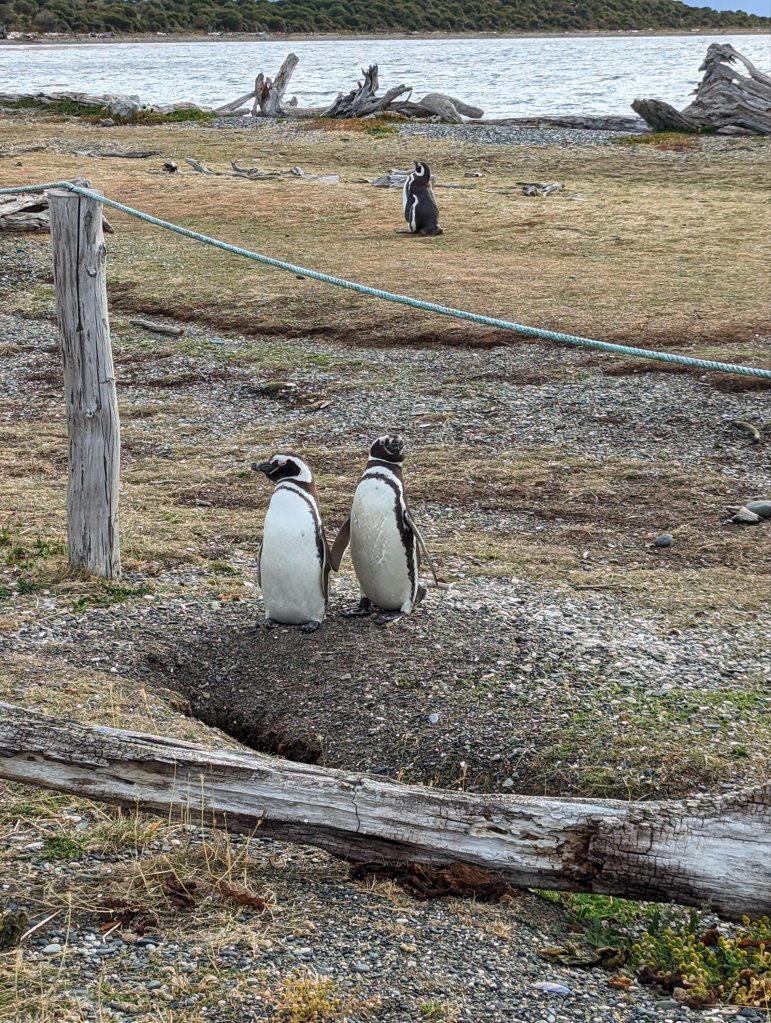
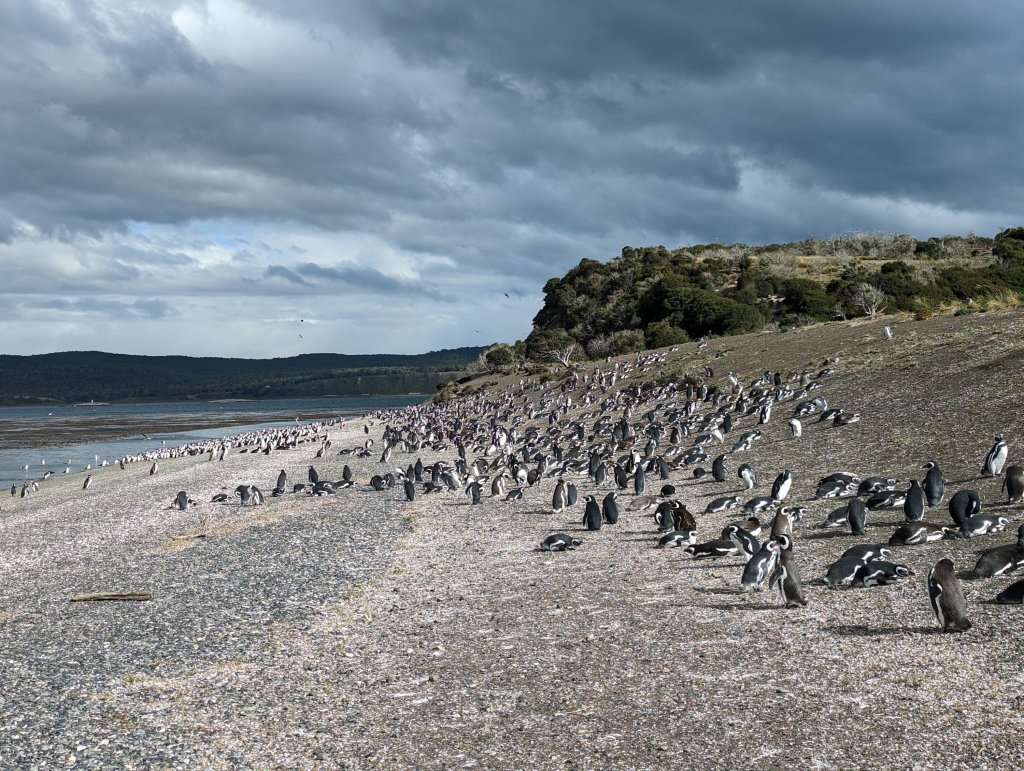
That same afternoon we boarded a bus to the Harberton ranch, 83 km east (most of that on a dirt road) to visit the penguins that nest on their island property. The 1 1/2 hour bus ride took us through valleys between spectacular mountains with inordinate numbers of fallen deciduous trees and limbs on the dense forest floor. Snow covered peaks surrounded us until we emerged on the Beagle Channel further East and across from Puerto Williams and Chile. I know, it’s weird that Chile owns an island east and south of Argentina (Papal mediation resolved the Argentine-Chile conflict over ownership of these islands in the late 1970’s, though Chile did support the UK in the Falkland Islands war in the 80’s). Once arrived at the estancia, we boarded a Zodiak and boated 10 min through choppy waters to the island. Quietly disembarking, we walked around Magellanic and Gentoo penguins who have been nesting here since October. There were large groups of juveniles in a sort of ‘daycare’ being watched by a few mature birds while the other adults worked: feeding, gossiping, hanging about elsewhere (kinda like my parenting. Sorry, kids). Sea lions swam about and penguins zoomed through the water while some waddled close by, oblivious to us. It was magical.


Returning to the estancia, we got an overpriced tour of the place, basically a 5 min overview of the family history. The current owners are 6th generation descendants of the original owner, Thomas Bridges, a former Anglican missionary from England. Also on site, a museum with a pretty extensive collection of Cetacean skeletons: whales, dolphins, and also sea lions. Apparently the third generation owner’s wife, originally from Ohio, was a collector and this tiny museum is now the largest Cetacean collection in all of Latin America! The docent imparted some really great info on all the various species which I hope to remember for my next trivia game. The bus ride back seemed significantly longer and more nauseating but after 7 hours we were back in Ushuaia. Next installment: adventure cruising to Cape Horn!


 My new reality